
Walter Deacon (1890-1974)
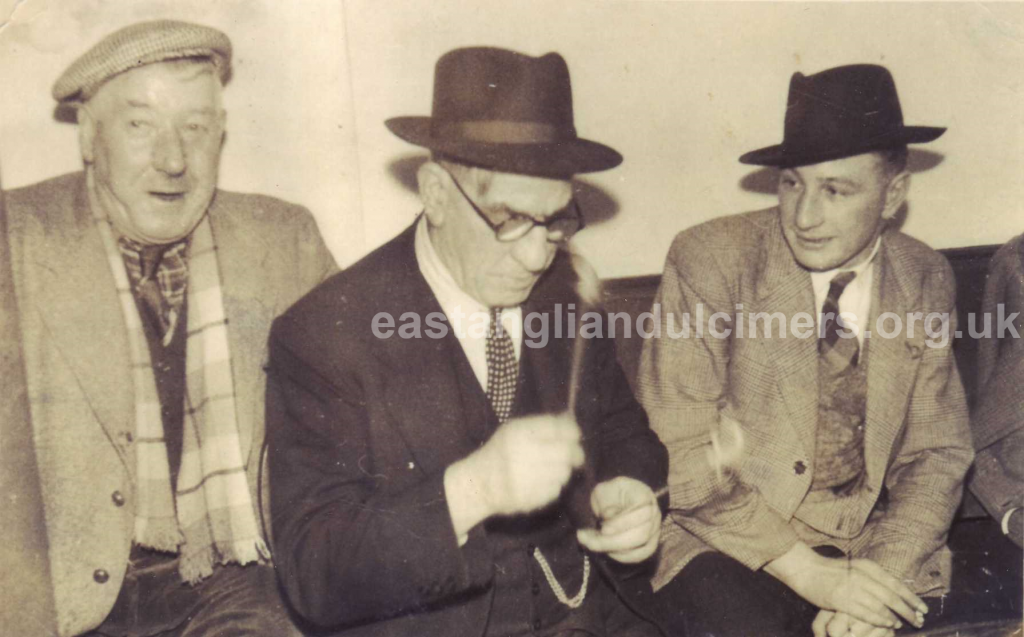
Walter Deacon was born in Cawston in late 1890 but by 1897 the family had moved to Roudham. His father’s job was a plate-layer on the railway, and by 1908 Walter was also employed by the Great Eastern Railway. In 1909 he married Agnes Maud Martins from Shotesham St Mary, and by 1911 they were living in Thorpe Hamlet, Norwich, close to the railway station, and Walter had become a plate-layer. Walter’s parents and grandparents had lived north east of Norwich, in the small village of Lammas, but he and his wife and young family moved further west, settling by 1917 in the hamlet of Broom Green, near North Elmham, between Norwich and Fakenham. There they lived in a cottage owned by the railway company for the rest of their long lives. Walter became a foreman with two hobbies, gardening and playing the dulcimer.
His granddaughter, Jean Curson, recalled that Walter used to walk up the lane to the King William pub (the ‘King Billy’) in Broom Green and play in there, and his wife Agnes would dance and sing. She remembered her grandmother as being dressed all in black, with a black hat with fresh flowers on, and she smoked a clay pipe. Mrs Curson remembered sitting outside the pub and listening to her grandfather playing the dulcimer. In the winter Walter used to play by the fireside. He played mostly on his own, but an aunt and uncle of Mrs Curson also played piano and violin with him sometimes. Walter’s son Trevor played piano accordion.
Dulcimer historian David Kettlewell must have met, or known of Walter, as in his thesis he wrote that Walter was not ‘currently playing, as he has no instrument’. Kettlewell’s thesis was published in 1976, by which time Walter Deacon had actually died.
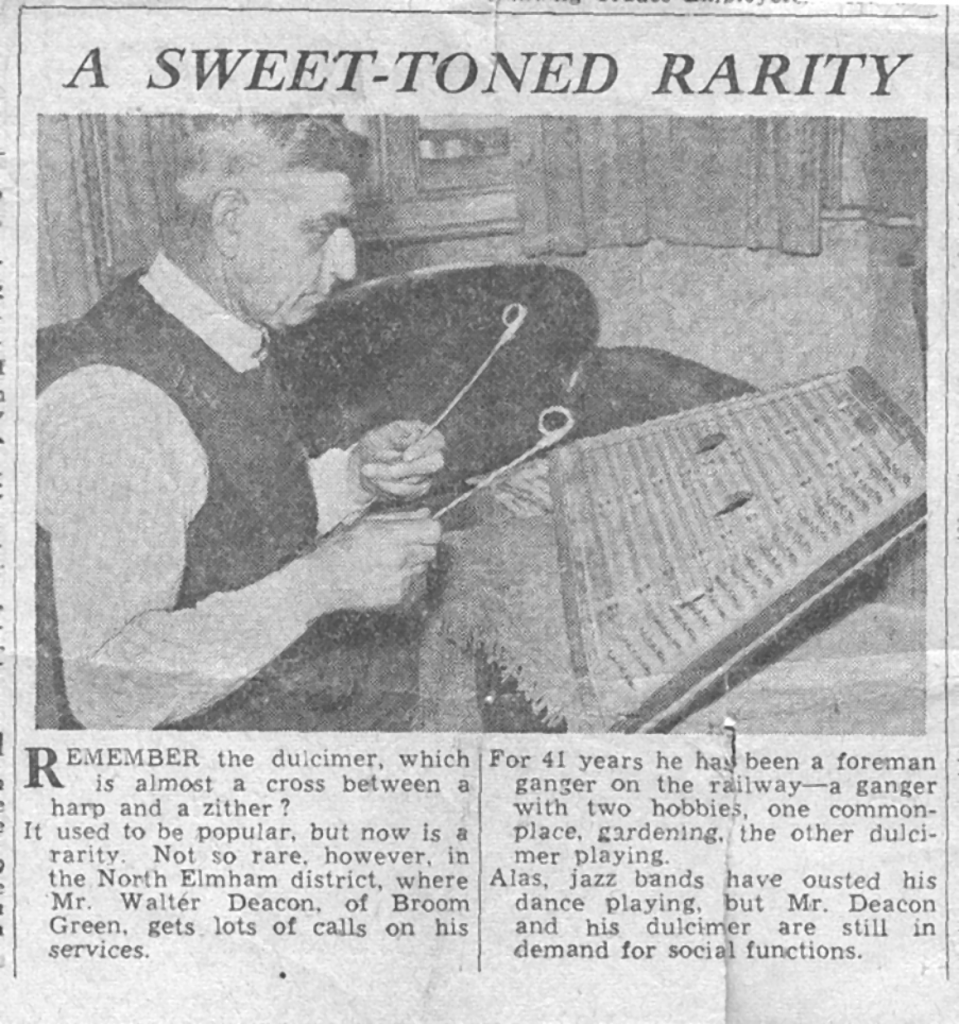
An article in the Eastern Daily Press from 1955 implies that Walter had in the past played for dancing, and that he was still active as a musician for community events. In the photo his dulcimer appears to have a plain wood top and 5 strings per course over 21 bridges. He is seen playing with the traditional curved canes bound with wool and the dulcimer is propped at angle which implies it has an integral stand underneath.
All material on this website is copyright. Anyone wishing to quote or use this original research should credit it to Katie Howson and cite this website as the source. Please see our Terms and Conditions page for more information, and do contact me if you wish to use any of the contents in any way. Thank you.