
Herbert Remmington (1876-1960)
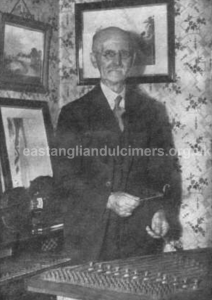
Herbert Charles Remmington was born in early 1876 in Hainford, where in 1879 his father, Charles, was working as a blacksmith, having taken over what had been his father’s business, whilst the latter had become a beer retailer. Herbert’s mother’s family (Spinks) were also in the licenced trade, her parents running the Goat Inn in Skeyton from about 1862 to 1892, taking over from her grandparents who had previously kept the other pub in Skeyton, the Black Horse.
By 1891, when Herbert was 15, his family had moved into Norwich and were in Albany Street; his father was now working as a carriage smith and Herbert as a ‘photographer’s artist’.
In 1901 Herbert, wife Margaret and two-year old daughter Alice were at Cock Street, Wymondham and he is listed as a self-employed photographer. Alice was born in Wymondham, so they had been there since at least 1898, probably moving soon after their marriage earlier that year. By 1903, Herbert and Margaret had taken on a pub, the Papermaker’s Arms pub in Swanton Morley, but by August 1904 the licence had passed to someone else. At this point they had two young children, and Margaret would most probably have been working in the pub at least some of the time whilst Herbert carried on his photography business in the daytime.
By 1906, they had moved to Briston, Melton Constable. We know this due to the sad fact that their 4 year old son, Herbert, died and was buried in Briston in July of that year. Herbert worked as a photographer from his home in Church Street, where his address was sometimes given as ‘The Studio’. At a later date they moved house but he and Margaret remained in Briston for the rest of their lives.
Articles in the local newspapers reveal some of his activities at the time: in 1908 he played violin with a Mr H.J. Roberts on piano for a smoking concert and dance, and by 1914 his daughter Alice had joined them, playing dulcimer for a “patriotic social” in Briston. Other reports mention playing at various functions around the area where members of the audience would give songs to entertain each other, and Herbert acted as accompanist – probably on the violin. A couple of reports from 1909, of “darkie frolics” and ‘Professor Remmington’s Travelling Theatre with its full complement of n****r minstrels’ in a parade in aid of a local nursing fund, illustrate how popular and pervasive amateur minstrel entertainments were at community events in this period. Dulcimer player Billy Cooper from Hingham also participated in such performances. “H.J. Roberts” was also called Herbert, and was a neighbour of Herbert Remmington’s, a few years younger, whose mother was a music teacher.
A later article in a local paper, The Journal, from 8th September 1950 (see below), provides some interesting details about Herbert Remmington’s life: he described how as young lad in the 1890s he had tramped around the villages of Norfolk with his camera and portable dark room and that the first place he went to was Briston. He said that when he decided to leave Norwich through ill health, he decided to settle there. The article also makes it clear that Herbert was a talented artist who sold paintings, and there were local memories of his photographic studio portraits having hand-painted backgrounds with an arched window – a popular style at the time.
Herbert had learned to play the violin before taking up the dulcimer. He made his own dulcimer just after the 1914-18 war, ‘when Norwich was the home of the dulcimer’ and claimed to have played it in nearly every village hall and gentleman’s house in north Norfolk! However the family owned a dulcimer before that, as his daughter was playing one in 1914 according to a report from November that year – whether he misremembered the date or whether they had bought one before he ventured into making them himself is not known.
Herbert also played the piano, taught others and tuned instruments. There are memories of him playing the fiddle for stepdancing in the Briston Chequers and entertaining audiences with popular song tunes in other pubs. Others recalled hearing him play the dulcimer in his house and he also went out and about with the local quoits team, taking his dulcimer or one-string fiddle with him.
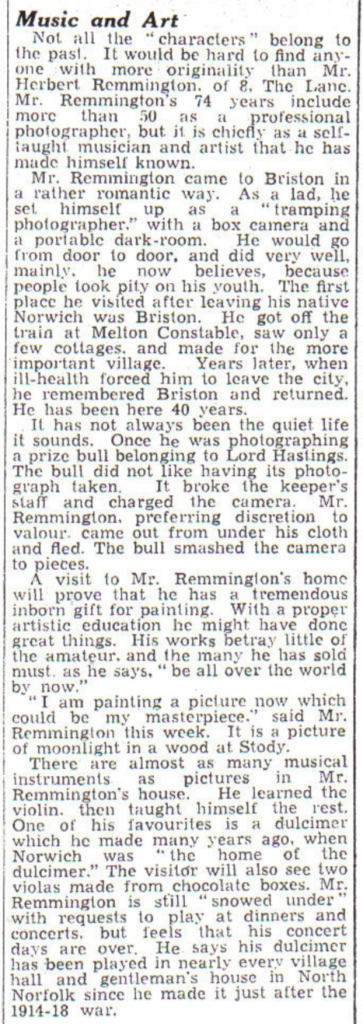
Herbert Remmington’s dulcimer
From the 1950 newspaper photograph, Herbert’s dulcimer can be seen to have twelve courses of bass strings, and it looks as though they are five strings per course. The instrument looks to be quite large, which it would need to be to accommodate so many courses of strings.
All material on this website is copyright. Anyone wishing to quote or use this original research should credit it to Katie Howson and cite this website as the source. Please see our Terms and Conditions page for more information, and do contact me if you wish to use any of the contents in any way. Thank you.