
Marcus Grice (1866-1972)
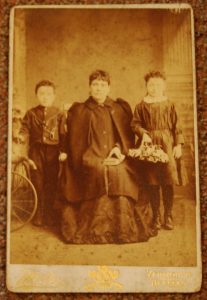
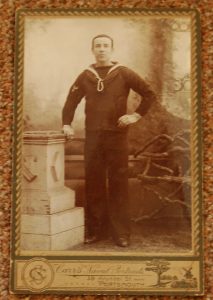
In late 2025, I was contacted for some advice by one of the Norfolk museums, which had been approached by someone wishing to donate a dulcimer. The museum were not particularly interested in accepting the item, as they already had a dulcimer or two in their collection, and so the owners had not actually deposited the instrument with them. The owners kindly agreed to let me look at the instrument and talk about the family member who had played it. This was Marcus William Grice, the great uncle of the 2025 owner, Linda Howlett. When Linda was growing up, Marcus had lived next door to her family on Slip Road. Marcus had also owned another cottage nearer the village centre and in about 1967, when Linda was a young teenager, she went there to help her great uncle clear out some belongings. The house was empty but this is where the dulcimer was! He said if she would like the dulcimer she could have it, and they carried it (or maybe pushed it in a wheelbarrow!) back to the Slip Road cottages where it remained for nearly 60 years.
Marcus was born in December 1886, the second child of Frederick and Matilda (née Minister). Marcus was named after his mother’s youngest brother. In the 1891 census, Marcus and his older sister Tilly were living with their parents in Slip Road, Thurlton. Their father was a bricklayer and had been born in Norton Subcourse, where his parents Joseph and Ann kept the Swan from 1866 to 1881, as well as farming.
Their mother Matilda, who had been born and brought up in Thurlton, died in 1894, when Marcus was just seven. By the 1901 census, his father had moved to Kirkley with his second wife Elizabeth, taking his daughter Matilda with him, but Marcus remained in Thurlton, living with his widowed and childless aunt Sarah Roberts (one of his mother’s sisters). In 1903, aged 17 and working as a farm labourer, Marcus shows up in a report of evening classes at the village school, where he was clearly intent on improving his prospects by attending classes in commercial geography, commercial arithmetic, elementary rural science, freehand drawing, and scale drawing. In 1909 he enrolled in the Royal Navy and in 1911 he was living in naval barracks in Portsmouth. At the time of his enrolment he was described as having brown hair and grey eyes, being 5’ 6” tall, having a scar over his right eye and a deformed little finger on his right hand.
On the night of the 1921 census (June) he was staying with his sister, Matilda and her second husband John Royal Smith, who were back in Thurlton, living in Low Road. Matilda died in 1929 and the 1939 register shows her widowed husband, her son and daughter still living in Low Road. When Marcus finally left the Navy in 1945, he chose to come back to Thurlton, where his only living family were, and where, presumably, he had happy childhood memories.
The dulcimer is likely to have been made before Marcus’ time (see below). It could have belonged to his father Frederick or grandfather Joseph, or to his mother Matilda, or aunt Sarah, or of course, he could have bought it second hand. He joined the Navy when he was 23 and was away at sea pretty much until he retired in 1945. To me this strengthens the suggestion that it was already in the family.
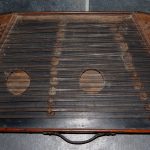
Marcus Grice’s dulcimer
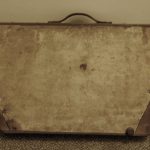
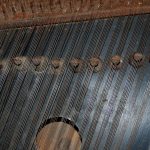
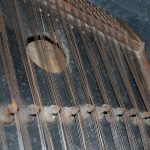
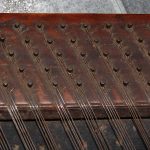
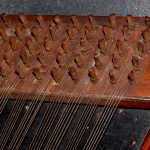
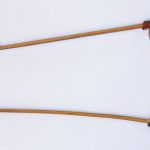
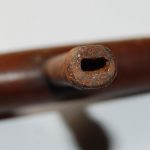
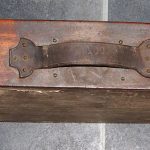
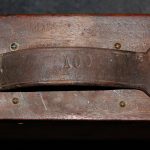
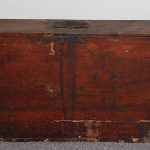
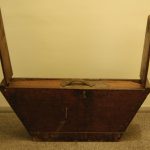
The dulcimer is quite small, with a plain black top, two soundholes with no inserts and 20 chessmen bridges with 5 strings per course. All the bridges and most of the wires are present, but the instrument is badly out of tune. The pegs are flat, suggesting an early date for manufacture (c.1850-1870). A tuning key and a pair of cane beaters bound in wool and felt were with the instrument. One cane is bound in red wool, one in white, perhaps indicating which hand to hold them with. The instrument has an integral leather handle, very sturdily made, which is imprinted with the number 100 and possibly two letters afterwards, but these are illegible. The case has a distinctive opening mechanism, reminiscent of the design of a double-leaf bascule bridge. The dulcimer slides in through the longest edge and the two ends close, leaving a slot in the middle where the integral handle pokes through, and there are then two small latches to secure the case.
All material on this website is copyright. Anyone wishing to quote or use this original research should credit it to Katie Howson and cite this website as the source. Please see our Terms and Conditions page for more information, and do contact me if you wish to use any of the contents in any way. Thank you.