
James Ellis
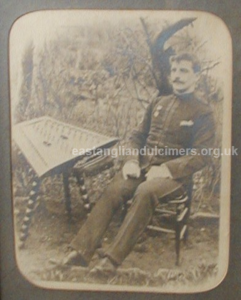
A dulcimer, case and photograph were donated to the Norfolk Museums Service in 1974 by a Mrs Mann of Bayford Hotel, Asplands Road, Norwich. The photographs were part of a set of four of her grandparents and uncles James and George Ellis. Since that time, the items themselves seem to have been dispersed around the county museums and there was insufficient evidence to identify the musician in the picture.
However we can now confidently say this is Samuel James Ellis (1875-1941) from the Thorpe Hamlet area of Norwich. He was known as James, had a brother called George, and the key piece of evidence is the 1939 register which shows him living with his sister, Ethel Bayford at Asplands Road. Their father, James senior was licensee of the William IV pub in Thorpe Hamlet from 1888 to 1913, whilst James himself worked in a variety of jobs including tram car driver, barman and in later years on the railways. In 1915 he enlisted and his military records describe him thus: “5’5” tall, blue eyes and dark hair, weight 9st 6lb. Chest – 37”, expansion 2”. Character – good.” He was invalided out of the army on account of a heart murmur in 1916 and then worked for the railways in engineering maintenance and repair. He served in the Army Veterinary Corps, but the uniform in the picture seems very different; the most similar style we have found is for a Citadel Army Band from 1905.
James Ellis’ dulcimer – a bit of a mystery!
The photo above shows James Ellis’ dulcimer to have been fairly plain looking, with two soundholes and 20 visible bridges. He seems to have a specially-designed table with barley twist legs, and a shelf at the front which held his cane beaters and other accessories. From the angle at which the dulcimer sits it looks as though the table had an inbuilt device to hold the dulcimer at a good playing angle.
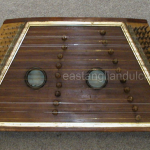
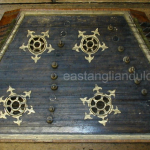
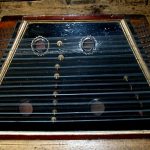
This photo of James Ellis was seen in the early 2000s, at which time it was held in the Strangers Hall Museum in Norwich. At the same time we also saw and photographed the dulcimers then held in store there, but neither of them matched the one in the Ellis photograph, as they both had four sound holes with gilt decoration around them (see Chris Self). There was another dulcimer then at Gressenhall Museum, Norfolk (and possibly at the Time & Tide Museum in Yarmouth later), which is probably the Ellis instrument as it has a plain top, 20 bridges and two soundholes.
All material on this website is copyright. Anyone wishing to quote or use this original research should credit it to Katie Howson and cite this website as the source. Please see our Terms and Conditions page for more information, and do contact me if you wish to use any of the contents in any way. Thank you.